


Koksiks
Koksiks atau dalam bahasa Inggeris disebut coccyx (/[invalid input: 'icon']ˈkɒksɪks/ KOK-siks; jamak: coccyges), adalah perkataan yang digunakan dalam istilah perubatan bagi bidang muskuloskeleton yang merujuk kepada tulang sulbi. Tulang sulbi atau tulang ekor adalah segmen terakhir kolum vertebra bagi golongan homo misalnya manusia (homosapien). Koksiks merangkumi 3 hingga 5 vertebra berasingan (ruas) atau vertebra coccygeal yang terletak dibawah sakrum. Koksiks disambung dengan sakrum oleh sendi fibrokartilaginos dan sacrococcygeal symphysis, yang membenarkan penggerakan terhad antara sakrum dan koksiks.
Istilah koksiks diambil dari bahasa Inggeris iaitu coccyx, asalnya dari perkataan Yunani κόκκυξ yang bererti "cuckoo",[1] merujuk kepada bentuk melengkung paruh cuckoo apabila dilihat dari sisi.[2][3]
Imej tambahan[sunting | sunting sumber]
-
 Vertebral column.
 -
 Vertebral column.
 -
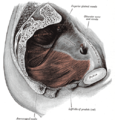 Left Levator ani from within.
 -
 Median sagittal section of male pelvis.
 -
 Median sagittal section of female pelvis.


Lihat juga[sunting | sunting sumber]
- Coccydynia (coccyx pain, tailbone pain)
- Istilah tulang-tulang
- Istilah lokasi anatomi
- Ganglion impar
- Human vestigiality
Nota[sunting | sunting sumber]
Rujukan[sunting | sunting sumber]
- Foye P, Buttaci C, Stitik T, Yonclas P (2006). "Successful injection for coccyx pain". Am J Phys Med Rehabil. 85 (9): 783–4. doi:10.1097/01.phm.0000233174.86070.63. PMID 16924191.CS1 maint: multiple names: authors list (link)
- Foye, Patrick M (June 3, 2008). "Coccyx Pain". eMedicine. Unknown parameter
|coauthors=ignored (|author=suggested) (bantuan) - Kim NH; Suk KS] (1999 Jun). "Clinical and radiological differences between traumatic and idiopathic coccygodynia". Yonsei Medical Journal (40:3). Check date values in:
|year=(bantuan)CS1 maint: multiple names: authors list (link) - Kunimatsu, Yutaka; Nakatsukasa, Masato; dll. (December 2007). "A new Late Miocene great ape from Kenya and its implications for the origins of African great apes and humans". PNAS. 104 (49): 19220–5. doi:10.1073/pnas.0706190104. PMC 2148271. PMID 18024593. Dicapai pada January 2010. Explicit use of et al. in:
|author=(bantuan); Check date values in:|accessdate=(bantuan)CS1 maint: multiple names: authors list (link) - Maigne JY, Molinie V, Fautrel B. (1992). "Anatomie des disques coccygiens". Revue de Médecine Orthopedique. 28.CS1 maint: multiple names: authors list (link)
- Maigne, J-Y (2000). "Causes and Mechanisms of Common Coccydynia. Spine". 25 (23). coccyx.org. Unknown parameter
|coauthors=ignored (|author=suggested) (bantuan); Cite journal requires|journal=(bantuan) - Miranda EP, Anderson AL, Dosanjh AS, Lee CK (2007). "Successful management of recurrent coccygeal hernia with the de-epithelialised rectus abdominis musculocutaneous flap". J Plast Reconstr Aesthet Surg. 62 (1): 98–101. doi:10.1016/j.bjps.2007.08.002. PMID 17889632. Unknown parameter
|month=ignored (bantuan)CS1 maint: multiple names: authors list (link) - Nakatsukasa, Masato (2004 May). "Acquisition of bipedalism: the Miocene hominoid record and modern analogues for bipedal protohominids". Journal of Anatomy. 204 (204(5)): 385–402. doi:10.1111/j.0021-8782.2004.00290.x. PMC 1571308. PMID 15198702. Check date values in:
|date=(bantuan) - Morris, Craig E. (2005). Low Back Syndromes: Integrated Clinical Management. McGraw-Hill. ISBN 0071374728.
- Postacchini F, Massobrio M] (1983). "Idiopathic coccygodynia. Analysis of 51 operative cases and a radiographic study of the normal coccyx". The Journal of bone and joint surgery (ed. American volume) (65(8)). Unknown parameter
|month=ignored (bantuan) - Saladin, Kenneth S. (2003). 3rd (penyunting). Anatomy & Physiology: The Unity of Form and Function. McGraw-Hill.
- Saluja PG. (1988). "The incidence of ossification of the sacrococcygeal joint". Journal of Anatomy. 156.
Pautan luar[sunting | sunting sumber]
- Templat:GraySubject
- Makmal SUNY 41:os-0107 – "The Female Perineum: Osteology"
- Coccyx pain: diagnosis, coping and treatment at coccyx.org
- Coccydynia (coccyx pain, tailbone pain) at eMedicine (Peer-reviewed medical chapter, available free online)
- Xray, MRI and other images about tailbone pain, at TailboneDoctor.com